
Song Tellers
On Museums, Mementos, Archives & Mattering

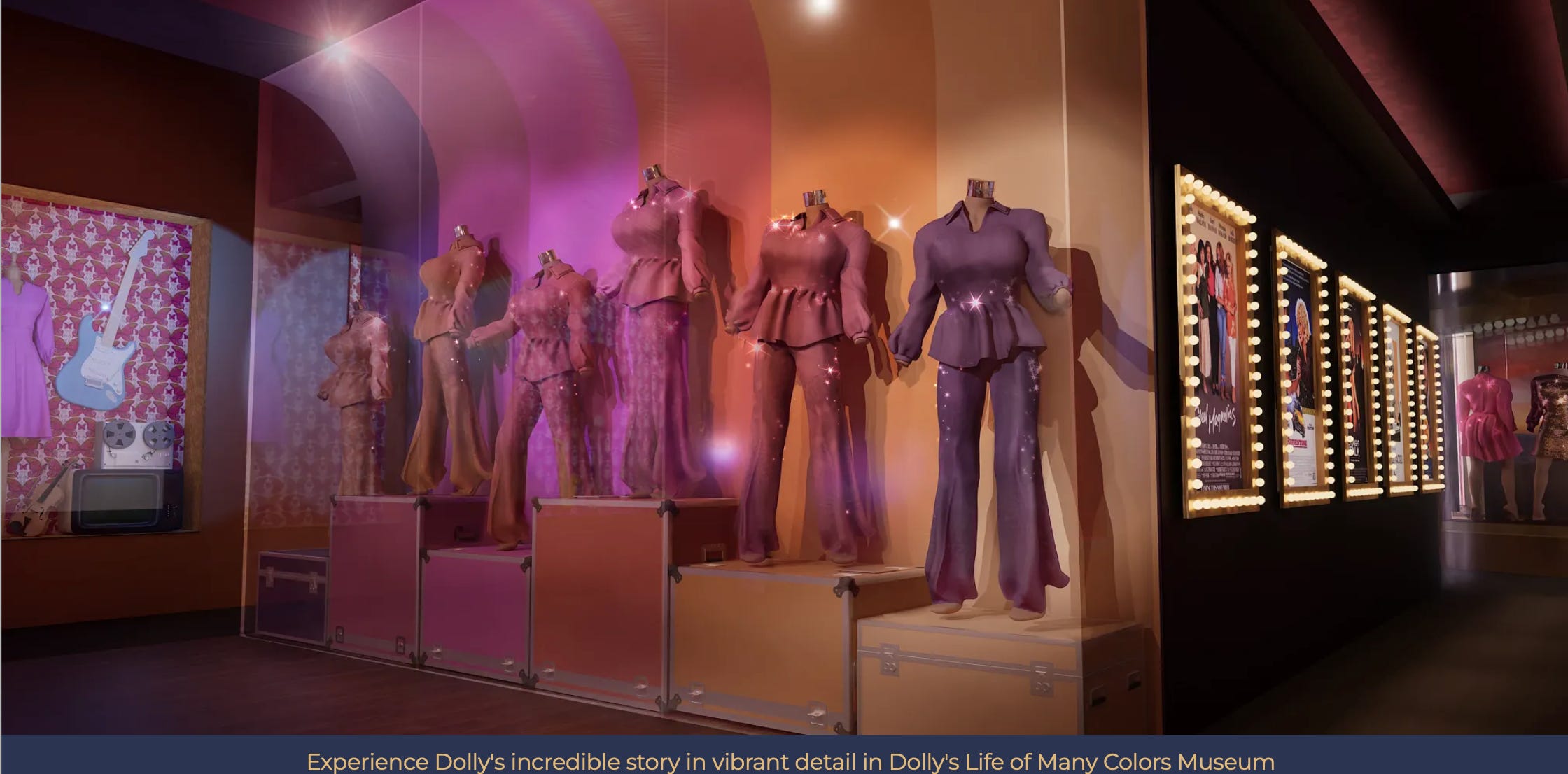
I was thrilled to learn that Dolly Parton has curated a monument to her own legacy at her Songteller Hotel in Nashville; the Life of Many Colors Museum that ‘invites fans to experience Dolly’s expansive career and most personal memories through the eyes of Dolly herself’. What else was she gonna do with all the bits and bobs and paraphernalia you collect throughout a lifetime of making music? Show it off! But on a serious note, this stuff matters. To witness all the work behind the glitz and the spotlights fires us up in unexpected ways.
I love musical ephemera, small souvenirs, tickets, flyers, photos of the moments behind the moments, scraps of paper that conjure meaning from dust. I still have a small golden ‘Dolly’ embossed box that once housed a chocolate butterfly, that my friend Jane brought me home from a hotel stay in Vegas where Dolly was performing in the late 80s. I have often considered throwing this now tattered small empty box out, but I just can’t. It means something to me, there’s some connection to a world of my musical dreams held inside that box and I can’t let it go.
In what seems to me to be a shameful reflection of our lack of appreciation for our collective cultural heritage in Australia, as far as I can tell, apart from the Kylie on Stage (2016-2018) costume gallery at the Arts Centre Melbourne the only other exhibition dedicated to a single female musical artist in Australia, was the 2016 Wendy Saddington: Underground Icon exhibition at the Canberra Museum and Gallery.
I’d like to see more cultural spaces lovingly preserving, curating and celebrating the worlds and experiences of musicians - like the Louis Armstrong House Museum in Corona, New York, Prince’s Paisley Park in Chanhassen, Minnesota, the Bob Marley Museum in Kingston, Jamaica and The Bob Dylan Center in Tulsa, OK.
I’ve mentioned this before but I’ll say it again in case there’s any philanthropic music loving readers out there who would like to make my cultural dreams come true, I’d love to open and curate a space for rotating immersive deep-dive multi-media exhibitions of Australian artists and their personal archives to educate, motivate and inspire visitors. It would be so special, and valuable to growing understanding of lives spent dedicated to working in music.
Here’s an excerpt from my book Lovers Dreamers Fighters, about why museums matter and what happened when I finally made it to Macon, GA, a place I was excited down to my bones to go because of its deep musical roots.
Macon, Georgia, is the birthplace of those thrillingly named luminaries The Architect of Rock’n’Roll, aka Little Richard; The King of Soul or The Madman of Macon, aka Otis Redding; and Soul Brother Number One, The Godfather of Soul, The Hardest Working Man in Showbusiness, Mr Dynamite, Mr Please Please Please, aka James Brown. The city was far smaller and greyer than I’d expected, considering the heft of its musical significance. The streets were desolate, even the impressive-sounding Martin Luther King Jr Boulevard where the museum was located. The highlight of the museum was reportedly Tune Town, a replica city with its own miniature Jazz & Swing Club, Vintage Vinyl and Rhythm & Blues Revue, a chapel, a cafe and Backstage Alley.
On our arrival I was dismayed to find that the doors of the museum were shuttered and padlocked, and had been for a few months. State funding had been cut due to low attendance, and despite a few passionate attempts to keep it afloat or take it elsewhere, the museum authority had voted to close it down. Thirty thousand books, records, artefacts, items of memorabilia and costumes were returned to donors, sold into private collections or moved into storage at the University of Georgia.
But I didn’t really need a museum. I tried to feel the remaining miasma of the musical ghosts lurking down every street and behind each doorway.
* * *
Etta James, aka Miss Peaches, told a story of touring through Macon on the Chitlin’ Circuit in the late 50s, supporting Little Richard with her band The Peaches on the back of their hit ‘Dance with Me Henry’ (originally written as ‘Roll with Me Henry’ before that was deemed too provocative for a group of young girls to sing). This was before Etta proclaimed herself ‘the female Otis Redding’ in the 1960s and covered his hits but after she ‘went steady’ with B.B. King as a teen and he wrote ‘Sweet Little Sixteen’ for her. Etta travelled everywhere with her beloved pet monkey, but the restaurant they stopped at for lunch refused to let her bring it inside. A young James Brown was hanging around out front, just hoping to get close enough to the musicians that some of their electricity might power him up. He offered to mind her monkey on the stoop, so she could eat, and gratefully she allowed him to help her out.
At this time young James carried around everywhere with him a treasured, tattered napkin on which Little Richard had scrawled, ‘Please, please, please’. James was determined to absorb these words and turn them into a song somehow – he was close enough to feel it. He recorded the finished song at Macon’s WIBB radio station, which broadcast from the basement of the Professional Building, the Launchpad for Southern Soul, and it indeed became his first hit. Next time Etta saw little James Brown, she was standing in the wings, side of stage, atThe Apollo in New York, and he was onstage singing ‘Please Please Please’.
Inspired by the two-sided folklore of this tale, I wrote and recorded a duet with Jed Kurzel and called it ‘Oh Apollo!’, for the dream destination they both made it to. I named my album It Walks Like Love, after a casual Etta aside that grabbed me on the outro of a song. The ongoing chain of inspiration, the never-ending domino effect,whispers on the wind from artist to artist. That’s where we find our call to arms.
Oh Miss Peaches, I will hold your monkey
While you eat, and in my pocket I keep
Torn paper crying, please please please …
The reel-to-reel recorder that compressed Mr Please Please Please’s irrepressible whoops and pleading shrieks to tape is on display in the Tubman Museum in Macon, which was closed on the day I visited, a Monday. It sits alongside the piano played by Little Richard at Ann’s Tic Toc Lounge, where he got his start as both dishwasher and entertainer, after its white rock’n’roll-loving owners adopted him when his preacher-bootlegger daddy kicked him out of home at fifteen years old for being ‘a sissy’. The genius boy king of self-invention went on to perform as Princess Lavonne in a red evening gown for Sugarfoot Sam’s Minstrel Show down the road to make some cash, before working on barely hidden odes to hot longing – ‘God Golly, Miss Molly’, ‘Long Tall Sally’ and ‘Tutti Frutti’ – while washing dishes at the Macon Greyhound bus station. Little Richard learned to play boogie-woogie piano from teenage musician Esquerita, later known as The Magnificent Malochi, after spotting him and his powerful pompadour as he disembarked from a bus late one night. Little Richard said he used to hang around thebus station hoping for action all the time, explaining, ‘I couldn’t sleep … and I would sit there all night watching people get off the bus … you understand.’ What a meeting of minds, what sparks must have flown between them, what a hotbed of hullabaloo ol’ Macon had going on! Down the road apiece at Club 15, James Brown attempted to murder Joe Tex with a shotgun for making fun of his caped stage act.
I squinted my eyes and tried to imbue the faded tumbleweed of a town with all the history and the myth and the romantic air of possibilities and wild devilry I wanted to eat up like candy. It was so hard to see. But it was, in fact, real. These originators of music as we know it took their dreamed-up selves, their hand-stitched capes and stuck-on sequins, and hit the road, poured their songs into hot wax and changed the world.
Tom Waits claimed that witnessing James Brown perform in San Diego back in 1962, when he was thirteenyears old, ‘was like putting a finger in a light socket … You’d been changed, your life is changed now. And everybody wanted to step down, step forward, take communion, take sacrament, they wanted to get close to thestage and be anointed with his sweat, his cold sweat.’
All hail the brave and beautiful trailblazers who have soundtracked our lives, and may we find exciting and innovative ways to preserve their legacies.
What’s the best music themed exhibition, museum or archive you’ve ever seen?
I’d love to take a trip to Slim Dusty’s museum, sounds like a dream! Great to learn it exists - and the pub with no beer! Thanks Job!
Having a library-archives background, I love museums and galleries. I have attended many exhibitions in my time. While my memory isn't great these days, a stand-out exhibition was the Bon Scott-AC/DC one at the Powerhouse Museum about 15 years ago. I visited Perth-Fremantle around the same time and there was a Bon Scott exhibition there, although I don't remember the venue. I have souvenirs from both events but they're at the bottom of my garage, somewhere.